
Remember when online research meant opening twenty browser tabs, scrolling endlessly through articles, comparing sources manually, and trying not to forget where you found that one important statistic?
That era is rapidly fading.
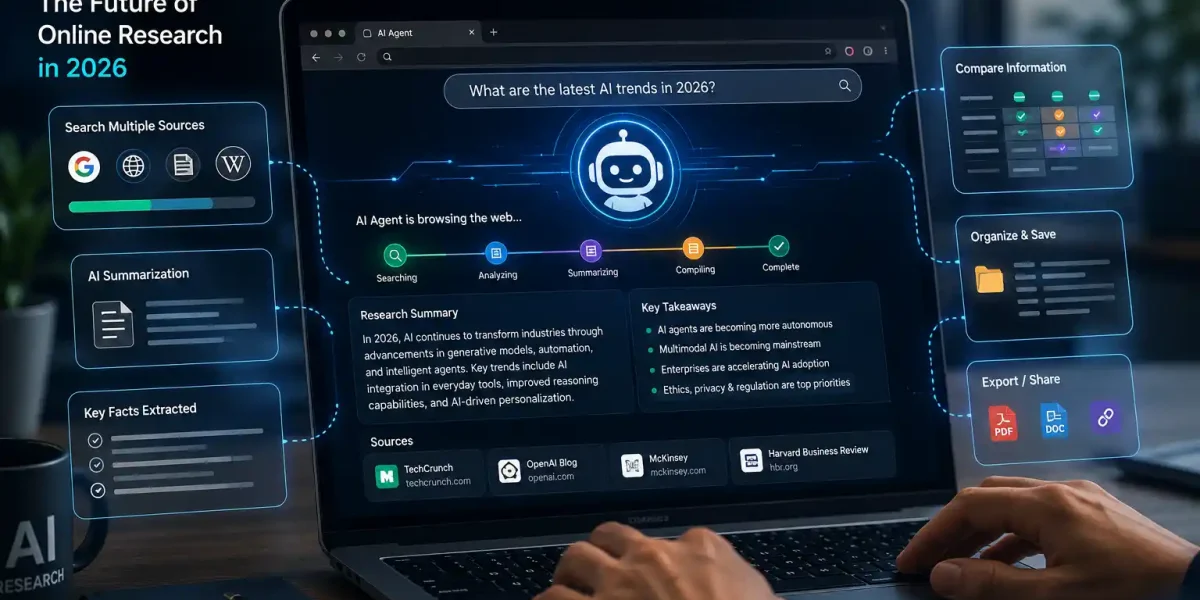
In 2026, a new generation of AI browser agents is transforming the way people discover, analyze, and organize information online. Instead of acting like traditional search engines that simply return a list of links, AI browser agents behave more like intelligent digital assistants. They can search, compare, summarize, verify, and even perform tasks on behalf of users.
For students, marketers, researchers, entrepreneurs, and professionals, this shift represents one of the biggest productivity breakthroughs of the decade.
The End of “Tab Overload”
For years, online research followed a familiar pattern.
You searched a topic on Google, opened multiple websites, skimmed through lengthy articles, compared conflicting information, copied notes into documents, and eventually built your own conclusions.
The problem is that the internet now contains more information than any human can realistically process.
By 2026, professionals are no longer struggling with information scarcity. Instead, they are battling information overload.
AI browser agents solve this challenge by acting as a layer between users and the overwhelming volume of online content. Rather than forcing users to visit dozens of websites, these agents gather relevant information automatically and present only what matters.
What Exactly Is an AI Browser Agent?
An AI browser agent is a smart assistant capable of navigating the web much like a human user.
Unlike conventional AI chatbots that rely primarily on pre-trained knowledge, browser agents actively interact with websites in real time. They can open pages, analyze content, extract useful information, compare sources, and complete browsing tasks.
Modern AI browser agents can:
- Research topics across multiple websites
- Compare products and services
- Summarize lengthy reports
- Extract key facts and statistics
- Monitor market trends
- Organize research findings
- Generate reports automatically
- Complete repetitive online tasks
In many cases, users can simply describe their goal and allow the AI agent to handle the entire research process.
Why Researchers Are Adopting AI Agents Faster Than Ever
The biggest advantage of AI browser agents is speed.
A task that once required two hours of manual research can often be completed in minutes.
Imagine a marketing professional researching competitors. Instead of opening dozens of websites individually, an AI browser agent can analyze competitor content, summarize pricing strategies, identify trends, and generate a structured report almost instantly.
Researchers and analysts are increasingly viewing AI browser agents as productivity multipliers rather than simple software tools.
How AI Browser Agents Actually Work
Behind the scenes, AI browser agents combine several advanced technologies.
First, they interpret the user’s request using large language models. Then they search multiple online sources simultaneously, identify relevant information, evaluate context, and organize the results into an easy-to-understand format.
A typical workflow looks like this:
Understanding Intent
The AI identifies what the user is actually trying to achieve.
Collecting Information
Relevant websites, databases, reports, and articles are scanned.
Analyzing Context
The agent separates useful information from irrelevant content.
Building Insights
The collected information is transformed into summaries, recommendations, or actionable conclusions.
Delivering Results
The user receives a concise and organized output instead of hundreds of search results.
This process dramatically reduces research time while improving information quality.
Industries Being Reshaped by AI Research Agents
Marketing and SEO
Marketers use AI agents to track competitors, identify emerging trends, monitor keywords, and analyze customer behavior.
Education
Students can quickly summarize academic papers, research reports, and educational resources without spending hours reading lengthy documents.
Journalism
News organizations use AI agents to gather background information, verify sources, and accelerate reporting workflows.
Business Intelligence
Companies rely on AI research tools to analyze markets, monitor competitors, and support strategic decision-making.
Technology
Developers and IT professionals use browser agents to track updates, analyze documentation, and discover solutions more efficiently.
The Challenges Still Facing AI Browser Agents
Despite their impressive capabilities, AI browser agents are not perfect.
Accuracy remains an important concern. AI-generated summaries can occasionally overlook critical details or misunderstand context.
Privacy is another major consideration. Since browser agents often interact directly with websites, users should carefully review how browsing data is collected and stored.
Most importantly, human judgment remains essential.
AI can accelerate research, but it should not replace critical thinking, source verification, or professional expertise.
What Will AI Research Look Like by 2030?
Industry experts believe today’s browser agents are only the beginning.
Future AI agents may be capable of:
- Conducting complete research projects autonomously
- Verifying facts in real time
- Generating professional reports automatically
- Managing entire knowledge bases
- Collaborating with teams across multiple platforms
- Performing complex multi-step research workflows
The long-term vision is clear: instead of searching for information, users will increasingly delegate research tasks to intelligent AI systems.
Final Thoughts
AI browser agents are fundamentally changing how knowledge is discovered and consumed online.
By eliminating repetitive research tasks, reducing information overload, and delivering actionable insights faster than ever before, these tools are redefining productivity in the digital age.
As the technology continues to evolve, individuals and businesses that learn to work alongside AI browser agents will gain a significant advantage in an increasingly information-driven world.
The future of research is no longer about finding information. It’s about having intelligent systems find, organize, and understand information for you.