The retail industry is undergoing a major transformation in 2026, driven by one powerful force: artificial intelligence.
What began as a technology used primarily by large corporations has now become accessible to businesses of all sizes. From local retailers to global brands, companies are leveraging AI to understand customers better, improve operations, and create smarter shopping experiences.
As consumer expectations continue to evolve, retailers are discovering that AI is no longer just a technological advantage. It is becoming a key driver of business growth.
The businesses embracing AI today are often the ones setting new standards for customer experience and operational efficiency.
AI Is Reshaping the Modern Retail Landscape
Retail has always been about understanding customer behavior.
In the past, businesses relied heavily on historical sales reports, market research, and intuition. Today, AI allows retailers to analyze vast amounts of data in real time and uncover insights that would be impossible to detect manually.
By identifying shopping patterns, predicting demand, and personalizing customer interactions, AI is helping retailers make faster and more informed decisions.
The result is a more responsive and customer-focused retail environment.
Personalized Shopping Experiences Are Driving Sales
Modern consumers expect personalized experiences.
They want product recommendations that match their interests, promotions tailored to their preferences, and shopping journeys that feel relevant rather than generic.
AI makes this possible.
By analyzing browsing history, purchase behavior, customer demographics, and engagement patterns, AI systems can recommend products with remarkable accuracy.
Retailers are using these insights to:
- Increase conversion rates
- Improve customer satisfaction
- Boost average order values
- Encourage repeat purchases
For many brands, personalization has become one of the most effective growth strategies of 2026.
Smarter Inventory Management
Inventory management remains one of the biggest challenges in retail.
Overstocking can tie up capital, while stock shortages can lead to lost sales and unhappy customers.
AI-powered forecasting tools help retailers predict future demand by analyzing:
- Seasonal trends
- Customer purchasing behavior
- Economic indicators
- Market conditions
- Historical sales data
This allows businesses to maintain optimal inventory levels and reduce waste.
Retailers using AI-driven forecasting often report significant improvements in inventory efficiency and profitability.
AI Is Transforming Customer Support
Customer service plays a crucial role in retail success.
AI-powered support systems are helping businesses provide faster and more consistent assistance across multiple channels.
Modern AI solutions can:
- Answer common customer questions
- Track orders
- Process returns
- Recommend products
- Provide shopping assistance
Unlike traditional chatbots, today’s AI systems can understand context and deliver more natural conversations.
This improves customer satisfaction while reducing support costs.
Dynamic Pricing Is Becoming More Common
Pricing strategy has become increasingly complex in competitive markets.
AI helps retailers adjust prices based on factors such as:
- Market demand
- Competitor pricing
- Product availability
- Customer behavior
- Seasonal trends
This allows businesses to maximize revenue while remaining competitive.
Many online retailers are already using AI-powered pricing systems to respond quickly to changing market conditions.
Visual Search and AI Shopping Assistants
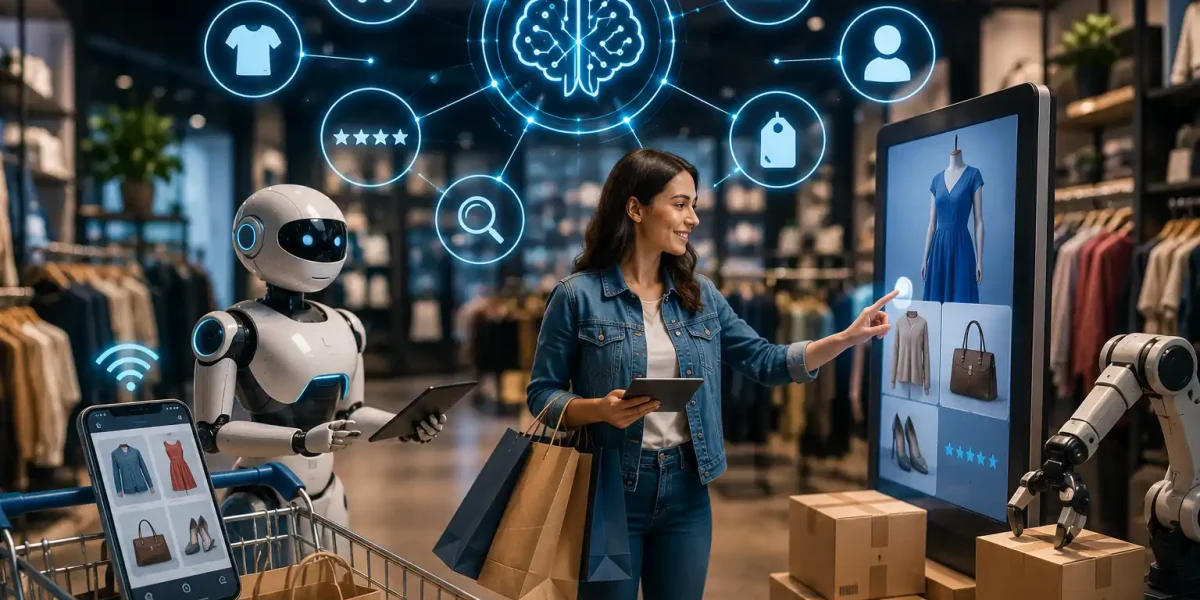
One of the most exciting developments in retail is the rise of AI-powered shopping assistants.
Customers can now:
- Upload product images
- Search visually
- Receive personalized recommendations
- Compare alternatives
- Discover new products instantly
These technologies are making online shopping faster, more intuitive, and more engaging.
Retailers that adopt such innovations often gain an advantage in customer acquisition and retention.
AI Helps Retailers Understand Customers Better
Customer data has become one of the most valuable assets in retail.
AI systems can analyze millions of interactions and identify patterns that reveal:
- Customer preferences
- Buying behavior
- Product interests
- Churn risks
- Loyalty opportunities
This intelligence enables retailers to make smarter marketing decisions and build stronger customer relationships.
Rather than relying on assumptions, businesses can make decisions based on real-time insights.
Challenges Retailers Must Address
Despite its benefits, AI adoption comes with challenges.
Retailers must carefully manage:
Data Privacy
Customer information must be protected and handled responsibly.
Integration Costs
Implementing AI solutions often requires investment and planning.
Accuracy
AI systems should be monitored to ensure reliable outcomes.
Employee Training
Teams need the skills to work effectively alongside AI-powered tools.
Businesses that approach AI strategically are more likely to achieve long-term success.
The Future of AI in Retail
Industry experts believe the role of AI in retail will continue expanding rapidly.
Future innovations may include:
- Autonomous shopping assistants
- Fully personalized storefronts
- AI-powered supply chains
- Predictive customer engagement
- Intelligent inventory ecosystems
As these technologies mature, retailers will gain new opportunities to improve efficiency and deliver exceptional customer experiences.
Final Thoughts
Artificial intelligence is becoming one of the most important growth engines in modern retail. From personalized recommendations and smarter inventory management to automated customer support and advanced analytics, AI is helping retailers operate more efficiently and serve customers more effectively.
In 2026, the most successful retail businesses are not simply adopting AI. They are integrating it into the core of their growth strategies. As competition intensifies, AI may prove to be the defining factor that separates industry leaders from the rest of the market.