
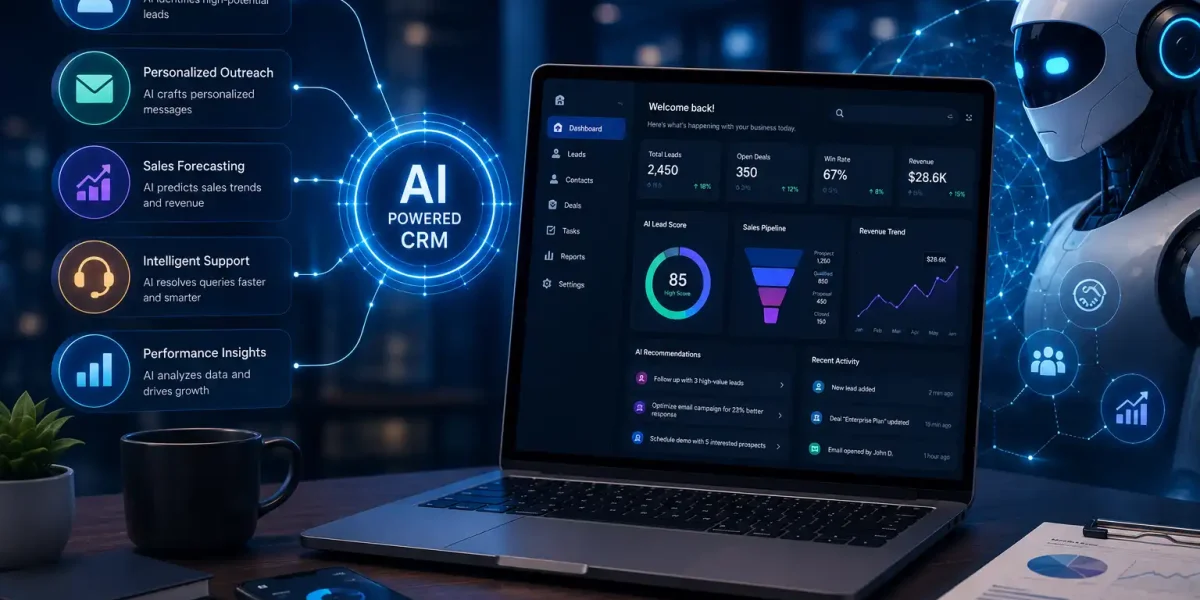
Customer relationship management is undergoing a major transformation in 2026. For years, CRM systems served primarily as digital databases for storing customer information, tracking sales activities, and managing communication records. Today, artificial intelligence is turning CRM platforms into intelligent business engines capable of predicting customer behavior, identifying sales opportunities, and automating complex workflows.
Businesses are no longer using CRM software simply to manage contacts. They are increasingly relying on AI-powered platforms to drive growth, improve customer experiences, and make smarter business decisions.
As competition intensifies across industries, AI-enabled CRM solutions are becoming one of the most important technologies businesses are investing in.
The Evolution of CRM in the AI Era
Traditional CRM platforms helped organizations organize customer data. However, extracting meaningful insights often required manual analysis and significant human effort.
Modern AI-powered CRM platforms work differently.
Instead of waiting for employees to interpret data, these systems actively analyze customer interactions, sales patterns, engagement trends, and buying signals in real time.
The result is a CRM that doesn’t just store information. It helps businesses understand what actions should be taken next.
This shift is changing how sales, marketing, and customer service teams operate.
Why Businesses Are Turning to AI-Powered CRM Systems
Customer expectations continue to rise.
Consumers expect personalized experiences, faster responses, and seamless interactions across multiple channels. Meeting those expectations manually becomes increasingly difficult as businesses scale.
AI-powered CRM platforms address these challenges by helping companies:
- Identify high-value prospects
- Predict customer needs
- Automate follow-ups
- Personalize communication
- Improve lead conversion rates
- Strengthen customer retention
Rather than reacting to customer behavior, businesses can now anticipate it.
Intelligent Lead Scoring Is Transforming Sales
One of the most valuable features of modern CRM platforms is AI-driven lead scoring.
Instead of relying on manual evaluations, AI analyzes dozens of customer signals, including:
- Website activity
- Email engagement
- Purchase history
- Social interactions
- Product interest
- Communication patterns
The system then ranks leads based on their likelihood to convert.
Sales teams can focus their efforts on the most promising opportunities instead of spending time on low-priority prospects.
This approach improves efficiency and often increases conversion rates significantly.
Personalized Customer Engagement at Scale
Personalization has become a key competitive advantage.
AI-powered CRM platforms help businesses deliver tailored experiences by analyzing customer preferences and behavioral patterns.
Modern systems can recommend:
- Personalized product suggestions
- Targeted email campaigns
- Custom sales messages
- Relevant support resources
- Individualized customer journeys
This level of personalization helps businesses build stronger relationships while improving customer satisfaction.
Predictive Analytics Is Changing Decision-Making
Many organizations are adopting AI CRM platforms because of their predictive capabilities.
By analyzing historical data and real-time interactions, AI can forecast:
- Future sales performance
- Customer churn risk
- Revenue trends
- Buying behavior
- Marketing effectiveness
These insights allow business leaders to make proactive decisions rather than reacting to problems after they occur.
For many companies, predictive intelligence is becoming one of the most valuable aspects of AI-driven CRM systems.
Automation Is Reducing Administrative Work
Sales and customer service teams often spend large amounts of time on repetitive administrative tasks.
AI-powered CRM platforms automate activities such as:
- Data entry
- Meeting scheduling
- Follow-up reminders
- Lead assignment
- Customer segmentation
- Performance reporting
By eliminating routine work, employees can focus on relationship building, strategic planning, and revenue-generating activities.
This productivity boost is one of the biggest reasons businesses are accelerating CRM modernization efforts.
Customer Service Is Becoming Smarter
AI is also transforming customer support through CRM integration.
Modern platforms can:
- Analyze customer inquiries
- Recommend responses
- Identify urgent issues
- Route tickets automatically
- Monitor satisfaction levels
Some systems even provide real-time guidance to support agents during customer conversations.
This improves response quality while reducing resolution times.
What Businesses Should Look for in 2026
As the CRM market becomes increasingly competitive, businesses evaluating new platforms should prioritize solutions that offer:
Advanced AI Capabilities
Systems should provide meaningful automation and predictive intelligence.
Seamless Integrations
CRM platforms must connect easily with existing business tools.
Strong Data Security
Customer information should remain protected through robust security measures.
Scalable Infrastructure
The platform should support future business growth.
User-Friendly Experiences
Complex technology should remain easy for teams to adopt and use.
Selecting the right CRM platform can significantly influence long-term business success.
The Future of AI-Powered CRM
Industry experts expect AI-powered CRM platforms to become even more intelligent over the next few years.
Future innovations may include:
- Autonomous sales assistants
- Real-time customer sentiment analysis
- Predictive revenue optimization
- Fully automated customer journeys
- AI-driven account management
As these technologies mature, CRM systems will increasingly function as strategic business advisors rather than software databases.
Final Thoughts
AI-powered CRM platforms are redefining how businesses manage customer relationships in 2026. By combining automation, predictive analytics, and intelligent decision-making, these systems help organizations deliver better customer experiences while driving growth and operational efficiency.
For businesses seeking a competitive advantage, investing in AI-enabled CRM technology is no longer simply a modernization project. It is becoming a strategic necessity in an increasingly data-driven marketplace.